
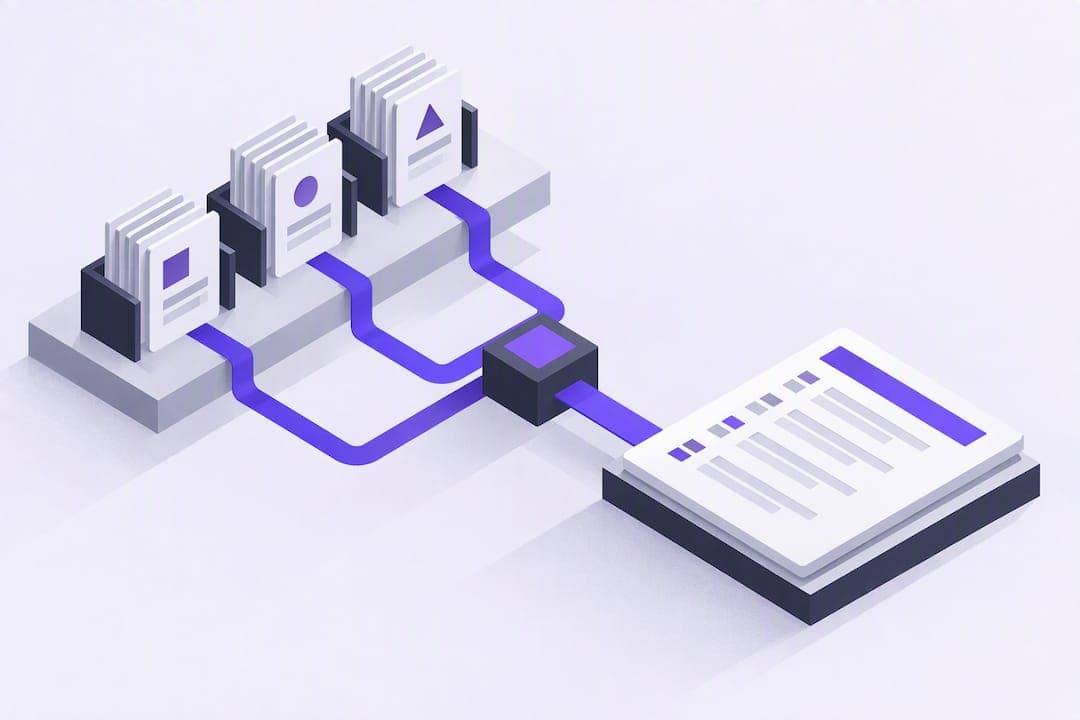
A full length practice test, in this sense, is a timed mock exam built from your own notes, slides, and past papers that mirrors your actual exam's structure, timing, and scoring. It works because it forces retrieval practice under real conditions, not passive review, and it hands you a diagnostic map of your weak spots. Start by gathering your slides, syllabus, and any past papers you can find.
TL;DR:
- Practice testing under exam conditions produces stronger long-term retention than passive review or re-reading notes.
- Building a blueprint from your course content ensures mock exams mirror your actual exam's question distribution and emphasis.
- Authentic exam simulations should replicate timing, question types, and context to better prepare you for real performance demands.
- Delay answer feedback until after completing full sections or the entire mock to maximize retrieval effort and learning benefits.
- Upload course materials, including past papers and slides, to generate tailored mocks that accurately reflect your exam's style and focus.
Table of Contents
- Why tailored full-length practice tests work
- Build a test blueprint from your course
- Mirror the real exam: question types, timing, and authenticity
- Feedback strategy: when to check your answers
- Preparing materials and generating a tailored mock with UExam
- Turn one mock into measurable improvement
- Why a tailored mock is rehearsal, not just practice
- How to order a tailored full-length mock from UExam
- Sources
- FAQ
Why tailored full-length practice tests work
The learning science here is not close. Re-reading notes feels productive, but retrieval practice consistently outperforms restudying for long-term retention, even though it is the strategy most students avoid. The effect holds across subjects and question formats, from short-answer recall to applied problem sets, according to an instructional resource on retrieval practice. A meta-analysis of practice testing confirms the pattern holds across a wide range of study designs, not just isolated classroom trials.

The mechanism is simple: the effort of pulling information out of memory, especially when it is difficult, strengthens the memory trace far more than reading the same information again. Feedback after that effort locks in the correction.
What this means for your prep:
- Reading slides twice feels safe but teaches you less than one timed attempt at recall.
- Struggling to answer a question, then getting the correct answer, builds a stronger memory than getting it right immediately.
- A full-length format matters because it rehearses stamina and pacing, not just content recall.
Students overwhelmingly default to the weaker method. A study on study habits found that 84% of students list re-reading as a primary strategy, even though practice testing produces better outcomes.
Build a test blueprint from your course
A blueprint turns your course content into a proportional map of what the real exam will ask, and it is the difference between a mock that feels random and one that feels like rehearsal. A practical guide to assessment blueprinting lays out a repeatable method.
- List every topic or learning objective covered in the course.
- Rate each one by how often it appears in lectures, assignments, or past papers.
- Sort each topic into "must know," "should know," or "nice to know."
- Assign question counts proportionally, weighting "must know" topics heaviest.
- Match cognitive level (recall, application, analysis) and question type to each category.
An illustrative split: for a hypothetical exam, more questions would be assigned to must-know topics than to should-know or nice-to-know, then adjusted based on how past papers weight those areas. Must-know items often suit direct recall or short-answer formats, while should-know and nice-to-know items can lean toward multiple-choice or brief application questions.
Pro Tip: Pull your weighting from past exam papers first. If a topic shows up in three of the last four papers, it belongs in "must know" regardless of how much lecture time it got.
Mirror the real exam: question types, timing, and authenticity
Format choice matters less than you might think. A study comparing quiz types found that both multiple-choice and cued-recall (short-answer) practice quizzes improved exam performance, with only a small difference between them. That gives you flexibility to match your source materials rather than chase a single "best" format.
- Multiple-choice items are fast to build and grade, and work well for should-know and nice-to-know content.
- Short-answer and problem-based items force fuller retrieval and suit must-know, high-stakes topics.
- Full-duration timing matters: a 90-minute exam rehearsed in three 30-minute chunks does not train the same stamina.
- Scheduling one full run under exam-like conditions, quiet room, no notes, one sitting, matters more than several fragmented reviews.
- Authentic context, such as scenario-based prompts, rubrics, or applied case data, makes items harder to guess and closer to what you will actually face, following authentic assessment design principles.
Feedback strategy: when to check your answers
The instinct to check each answer as soon as you finish a question undercuts the entire exercise. Feedback works best after a full retrieval attempt, not during it. Immediate per-question feedback lets you lean on recognition instead of recall, which weakens the retrieval effort that makes practice testing effective.
- Finish the entire section, or the whole test, before reviewing any answers.
- Use model answers or rubrics that specify what a complete response needed, not just a final number or letter.
- Read your performance breakdown by topic, not just overall score, to see where must-know gaps sit.
Pro Tip: Treat your first pass through results as diagnostic, not corrective. Note the pattern of misses before you start restudying anything.
Delaying feedback until after a complete attempt, whether that is a section or the full exam, produces stronger learning gains than checking after each question.
Preparing materials and generating a tailored mock with UExam
The quality of a generated mock depends entirely on what you feed it. Upload your lecture slides, the course syllabus, and any past exam papers you can find, since past papers are the clearest signal of real weighting and question style. Model answers, when available, help sharpen the feedback you get back.
Label files by topic or week where possible. That mapping lets the blueprint reflect your course's actual emphasis rather than a generic template, so a heavily tested unit in your slides shows up as a heavily weighted section in your mock.

What to expect from the output: a timed, full-length exam with a question mix drawn from your materials, automatic grading, and a topic-level feedback breakdown that flags weak areas. UExam builds these mocks directly from uploaded course content rather than a generic question bank, which is the core difference from static prep resources. Disciplines range from technical courses like Java and physics to broader general studies material.
Turn one mock into measurable improvement
A single mock exam is only useful if you act on it. Right after finishing, log your score and take a short break before looking at answers, resist the urge to peek mid-test.
- Rank your misses by must-know versus should-know or nice-to-know weighting.
- Spend the next study session on spaced retrieval practice targeting just the must-know gaps.
- Retest only those specific topics a few days later, not the whole exam again.
In the final weeks before a real exam, one full-length mock every week or two, spaced enough to allow real review between attempts, tends to work better than cramming several mocks back to back.
Why a tailored mock is rehearsal, not just practice
A generic practice test tells you whether you know a subject in general. A tailored one tells you whether you are ready for the specific exam sitting in front of you in a few weeks, built from the actual slides, syllabus, and past papers your instructor used. That distinction is the entire point.
Most students treat a practice test as one more study task to check off. We think of it as diagnostic input, the thing that tells you where the next study session should go, not a replacement for studying itself. A mock that mirrors your exam's format, timing, and question mix across disciplines, from calculus to business courses, gives you a rehearsal you can actually learn from.
— UExam
How to order a tailored full-length mock from UExam
Once you have your materials gathered, ordering a mock is a short process, not a project. UExam builds the exam from what you upload, so the only real prep work is on your end: slides, syllabus, past papers, and model answers if you have them.

- Mock exams: generated from your own course materials, with a free trial option available.
- Exam Pack: a one-off purchase option suited to a single upcoming test; current prices are on the pricing page.
- Finals Pack: a one-off purchase option built for broader final-exam coverage; current prices are on the pricing page.
- Grind Pack: a one-off purchase option for heavier or repeated practice needs; current prices are on the pricing page.
Gather your materials, check pricing and packs, upload your files, and generate your first mock. If you want to see how it works for your subject first, browse mock exam examples before you commit.
Sources
- Leverage the Testing Effect - Center for Teaching & Learning Innovation
- Retrieval practice — UC San Diego instructional resource
- Seven Steps to Construct an Assessment Blueprint: A Practical Guide
- Effects of Cued-Recall versus Recognition Retrieval Practice on Beginning College Students' Exam Performance
- Rethinking the Use of Tests: A Meta-Analysis of Practice Testing
FAQ
What makes a practice test "full length" versus a short quiz?
A full-length practice test covers the full duration and question count of your actual exam, rehearsing pacing and stamina, not just isolated topic recall. A short quiz tests a slice of content, while a full-length mock trains you to manage time across the entire assessment.
How many full-length mocks should I take before a real exam?
There is no fixed number, but spacing one mock every week or two in your final preparation phase, with review time between attempts, tends to work better than several mocks in quick succession. The goal is enough spacing to actually apply feedback before the next attempt.
Should I check answers after every question or wait until the end?
Wait until you finish a full section or the entire test before reviewing answers. Checking immediately after each question lets you lean on recognition instead of genuine recall, which weakens the learning benefit of the attempt.
What materials should I upload to generate an accurate tailored mock?
Upload lecture slides, the course syllabus, and past exam papers if you have them, since past papers show the clearest signal of real question weighting. Model answers, when available, help sharpen the feedback you receive on your results.
Does question format (multiple-choice versus short answer) matter for learning?
Both formats can improve exam performance, and the difference between them is often small. Choose the format that matches how your real exam is structured rather than assuming one format is inherently superior.